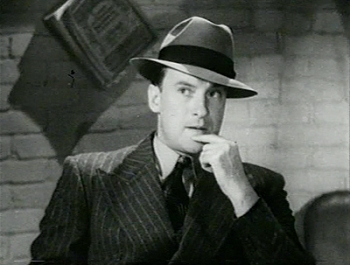
Elliott
Sullivan (Sullivan was a stage name, he was in Texas, the son of Rabbi Solomon
Solomon)
In 1956,
Sullivan was named as an active member of the communist party in testimony by
actors Jerome Robbins, Martin Berkeley,
Lee J. Cobb. The HUAC called Sullivan in for questioning. In refusing to
answer, Sullivan invoked not the Fifth Amendment against self‐incrimination but the First Amendment guaranteeing
freedoms of speech and association.
Chairman
Francis E. Walter of Pennsylvania warned Sullivan that by taking that route he
risked the possibility of a contempt citation and added that it didn’t seem to
make a difference to Sullivan one way or the other, meaning it was Walter’s
view that Sullivan had to the committee with the intention of being indicted
for contempt.
At that,
Sullivan screamed “Of course it makes a difference to me. Contempt—I have a wife
and two children and I'm anxious to work. I resent that remark that it doesn't
make a difference to me—that nonsense. It makes a very serious difference in my
entire life.”
Over the
next year, the committee gave Sullivan several opportunities to correct his
stance and take the Fifth, but he
refused and was indicted by a federal grand jury in 1957. He was acquitted by
Federal Judge Sidney Sugarman in 1961 in a one‐day
nonjury trial because of a technicality—the
prosecution's failure to include in the indictment the resolution ordering the
committee hearings.
A tall,
strong‐jawed Texan (he was born in San
Antonio, the son of Rabbi Solomon Solomon), he got his first Broadway walk‐on part in Morris Gest's presentation of “The Passion Play” in 1929. Mr. Sullivan also played in
“Winged
Victory,” the Norman Bel Geddes's production of “Lysistrata” and in “Brigadoon”
and “Compulsion.”
Being called
before the HUAC and being indicted seemed to have no actual effect on
Sullivan’s lackluster career. Sullivan made 84 films from 1936 until 1957. He
was uncredited in 67 of them. Prior to film, Sullivan was a stage actor. He never had a leading role, or, for that
matter, a large speaking role in his entire career. It’s also important to note
that Sullivan was 52 years old when he decided to take on the US federal
government. The number of roles available to a secondary actor, at that age,
were limited.
Sullivan
left the United States in 1962. From 1967 until he left films in 1972, Sullivan
made an additional 12 films. He was
uncredited. He was uncredited in three of them. He was essentially a background
extra in the remaining nine films.
1959
Lysistrata (Broadway)
The Great
God Brown (Broadway)
1958
The Power
and the Glory (Broadway)
Naked City
(TV)
Decoy (TV)
1957
Compulsion
(Broadway)
Brigadoon(Broadway)
Small War on
Murray Hill (Broadway)
The Joker Is
Wild (Film uncredited)
1956
Crowded
Paradise (Film, extra but credited )
1953
Taxi (Film
uncredited)
1952
Forgotten
Children (TV Movie)
1951
Repertory
Theatre (TV )
Somerset
Maugham TV Theatre (TV Series)
1950
Guilty
Bystander (film, a minor role, he is credited only as “A Stitch”)
So Young So
Bad (Film uncredited)
Danger (TV)
Starlight
Theater (TV 2 appearances)
The
Prudential Family Playhouse (TV)
Suspense (TV
2 appearances)
Pulitzer
Prize Playhouse (TV)
The Big
Story (TV 2 appearances)
The Trap (TV)
Hands of
Mystery (TV)
So Young So
Bad (TV)
Actor's
Studio (TV )
TESTIMONY
OF ELLIOTT SULLIVAN BEFORE THE HUAC
Mr.
Tavenner. Mr. Sullivan will be the next witness.
Mr.
Doyle. Mr. Sullivan, will you please raise your right hand?
Do
you solemnly swear to tell the truth, the whole truth and nothing
but
the truth, so help you God ?
Mr.
Sullivan. I do.
Mr.
Tavenner. What is your name, sir ?
Mr.
Sullivan. Elliott Sullivan.
Mr.
Tavenner. It is noted that Mr. Sullivan is accompanied by
the
same counsel who accompanied the preceding witness.
When
and where were you born, Mr. Sullivan ?
Mr.
Sullivan. I was born in San Antonio, Tex,, July 4, 1907.
Mr.
Tavenner. What is your present occupation ?
Mr.
Sullivan. I am an actor and director.
Mr.
Tavenner. Where do you reside?
Mr.
Sullivan. Permanently?
Mr.
Tavenner. Yes.
Mr.
Sullivan. In New York City.
Mr.
Tavenner. What is your present employment?
Mr.
Sullivan. I am the director of shows at Wingdale Lodge.
Mr.
Tavenner. Where is Wingdale Lodge located ?
Mr.
Sullivan. In Wingdale, N. Y.
Mr.
Tavenner. Will you tell the committee, please, what your
formal
educational training has been ?
Mr.
Sullivan. I graduated from high school and had, I guess, about
6
months of college.
Mr.
Tavenner. When did you move to New York ?
Mr.
Sullivan. In 1929.
Mr.
Tavenner. Will you tell the committee, please, what your
record
of employment has been since 1940 ?
Mr.
Sullivan. I was in Hollywood making motion pictures until
the
time I went into the Army, which was in 1943. I got out in 1945.
Then
I worked in New York and Hollywood since then, not consistently.
Mr.
Tavenner. Will you tell the committee, please, what the nature
of
your employment was in Hollywood ?
Mr.
Sullivan. I worked as an actor in motion pictures.
Mr.
Tavenner. What screen credits did you receive?
Mr.
Sullivan. There are about 80 of them.
Mr.
Tavenner. I mean give us some of them.
Mr.
Sullivan. The most notable was a picture called Each Dawn
I
Die. Most of those gangster pictures in the 1930's. I should be
able
to reel them off fast, but I can't recall any of the names at the
moment.
Three Sisters, Angels With Dirty Faces, Yankee Doodle
Dandy.
Mr.
Tavenner. What producers did you work for in Hollywood?
Mr.
Sullivan. I worked for all the major studios.
Mr.
Tavenner. When did your work in Hollywood begin?
Mr.
Sullivan. It began in 1937.
Mr.
Tavenner. While in Hollywood, did you at any time meet
V.
J. Jerome?
Mr.
Sullivan. I refuse to answer that question, sir, on the privileges
under
the fifth amendment.
Mr.
Tavenner. When did you take up your profession in New York
City?
Mr.
Sullivan. In 1929.
Mr.
Tavenner. When did you return from Los Angeles, from
Hollywood
— to New York City to continue with your profession?
Mr.
Sullivan. I went into the Army in Los Angeles, and when I
came
out I came to New York.
Mr.
Tavenner. Have you been in New York ever since ?
Mr.
Sullivan. Except for one motion picture that I made where
I
went to Hollywood.
Mr.
Tavenner. What motion picture was that?
Mr.
Sullivan. A picture called The Lady Gambles, with Barbara
Stanwyck.
Mr.
Tavenner. In what year did you return to Hollywood?
Mr.
Sullivan. I think it was 1948.
Mr.
Tavenner. Have you been connected with the operation of
any
summer camps other than Wingdale Lodge ?
Mr.
Sullivan. I worked, yes, sir, at White Lake. That was 2 years
ago,
1953, in the summer.
Mr.
Scherer. Is that a camp ?
Mr.
Sullivan. White Lake Lodge, I believe it is called.
Mr.
Scherer. Where is that located?
Mr.
Sullivan. It is on a place called "White Lake. It is close to
Monticello,
N. Y.
Mr.
Tavenner. Were you a member of the Communist Party while
working
at White Lake Lodge?
Mr.
Sullivan. I refuse to answer that question, on the same ground.
Mr.
Tavenner. Were you a member of the Communist Party while
employed
by Wingdale Lodge?
Mr.
Sullivan. I refuse to answer that.
Mr.
Dolittle. On what ground do you refuse to answer ?
Mr.
Sullivan. The privileges under the fifth amendment.
Mr.
Tavenner. What is the nature of your employment at Wingdale
Lodge
?
Mr.
Sullivan. I put on shows there.
Mr.
Tavenner. Are you the entertainment director ?
Mr.
Sullivan. There is no specific title given to me, nor did I choose
one.
I simply put on the shows.
Mr.
Tavenner. I have before me an advertisement of the camp
which
has been introduced in evidence as Friedman Exhibit No. 1,
which
refers to you as Elliott Sullivan, director. What does the word
"director"
refer to in the advertisement?
Mr.
Sullivan. It refers to directing the shows that are put on
there.
Mr.
Tavenner. Was your employment to direct shows that were
put
on at this camp ?
Mr.
Sullivan. That is correct.
Mr.
Tavenner. And you have been employed there two seasons?
Mr.
Sullivan. No ; just this year.
Mr.
Tavenner. As the director of these shows, do you choose those
who
participate in them ?
Mr.
Sullivan. No. The manager hires everyone.
Mr.
Tavenner. I noticed in Friedman Exhibit No. 1, that Lloyd
Gough
is one of those who was taking part in the program.
Mr.
Sullivan. Yes. I am familiar with it.
Mr.
Tavenner. Did you select Mr. Gough for the part that he
played
in that program ?
Mr.
Sullivan. Frankly, I don't remember exactly how it came
about.
The manager also knew Gough. It sort of evolved.
It
is possible that I may have been the one to suggest him.
Mr.
Tavenner. To Mr. Friedman, do you mean ?
Mr.
Sullivan. That is right.
Mr.
Tavenner. You say Mr. Friedman knew Mr. Gough ?
Mr.
Sullivan. I think he did. I am not positive about this, but I
seem
to recall his saying he did know him.
Mr.
Tavenner. Do you know whether or not you recommended Mr.
Gough
to Mr. Friedman ?
Mr.
Sullivan. The reason it may seem hazy to you is that a great
number
of people were under consideration when we were selecting
people,
or when he was throwing out names at me or I was throwing
out
names at him. I am actually not positive as to where this name
came
from first. It is quite possible that I might have mentioned
him.
I have known Lloyd Gough for a long time and worked in
plays
with him. I have known him to be an entertainer and a good
one.
Mr.
Tavenner. Did you know him as a member of the Communist
Party
?
Mr.
Sullivan. I refuse to answer that on the grounds of the fifth
amendment.
Mr.
Tavenner. Was he a member of the Communist Party, to your
knowledge
?
Mr.
Sullivan. The same answer.
Mr.
Tavenner. You knew at the time he was employed at this
camp
that he had appeared as a witness before this committee, did
you
not ?
(The
witness conferred with his counsel.)
Mr.
Sullivan. Yes, I did. I read it in the papers.
Mr.
Tavenner. You knew that he had refused to testify before
this
committee regarding alleged membership in the Communist
Party
on the ground that to do so might tend to incriminate him?
Mr.
Sullivan. I know that he did refuse to answer, yes.
Mr.
Tavenner. You knew that he had been identified in sworn testimony before this
committee as a member of the Communist Party,
did
you not?
Mr.
Sullivan. I simply remember reading about his having appeared and having
refused to testify. I don't remember anything about the testimony.
Mr.
Tavenner. Were there any other persons recommended by you
for
work at this camp who were known to you to be members of the
Communist
Party ?
(The
witness conferred with his counsel.)
Mr.
Tavenner. There might be an inference from the way I asked
the
question that should not be, so I desire to change the question.
Leaving
out of the consideration Mr. Gough, were there any persons
employed
at the camp for entertainment purposes who were known
to
you to be members of the Communist Party ?
Mr.
Sullivan. I refuse to answer that under the fifth amendment.
Mr.
Scherer. Mr. Sullivan, this summer you have regularly put
on
shows at the Camp Wingdale Lodge, have you not ?
Mr.
Sullivan. That is correct,
Mr.
Scherer. Do you recall the show directed by you on the night
of
July 2, that is, the Fourth of July weekend? Do you recall that
show
at Wingdale Lodge ?
Mr.
Sullivan. Can you refresh me whether that was a Saturday
or
Sunday ?
Mr.
Scherer. That was a Saturday night.
Mr.
Sullivan. Yes, I recall the show.
Mr.
Scherer. You participated in that show, did you not?
Mr.
Sullivan. That is correct.
Mr.
Scherer. You had 10 acts in that show, do you remember?
Do
you recall there were 10 acts?
Mr.
Sullivan. I don't recall exactly. It is possible. Ten sounds
right,
yes.
Mr.
Scherer. Let us see if this refreshes your recollection : The first
act
was a chorus line of 6 girls, the second was a comedy act by you.
Do
you recall that ?
Mr.
Sullivan. That is right.
Mr.
Scherer. And the third was a girl who sang. Do you remember
that?
Mr.
Sullivan. It is quite possible. I don't remember the exact
order.
Mr.
Scherer. Then the fourth act that you put on that night is the
one
that puzzles me a little bit and perhaps you can explain it. Let
me
refresh your recollection as to what happened. It was a very short
skit
in which you and another man participated. Do you remember
who
that man was ?
Mr.
Sullivan. Do you mean his name ? Do you want his name ?
Mr.
Scherer. Yes.
Mr.
Sullivan. I refuse to answer as to his name.
Mr.
Scherer. I ask that he be directed to answer.
Mr.
Doyle. I direct you to answer the question. We are not satisfied to accept your
answer as given as sufficient. You are directed to
answer
the question.
(The
witness conferred with his counsel.)
Mr.
Sullivan. I refuse to answer on the grounds — rather, under the
privileges
of the fifth amendment as to names.
Mr.
Scherer. Was this man who participated with you in this act a
member
of the Communist Party ?
Mr.
Sullivan. I refuse to answer that on the same grounds.
Mr.
Scherer. As I said, this skit or act was a very short one. I
would
like you to explain to me what it meant. It opened with you
saying
to the other man, "Want to buy a copy of the Bill of Rights?"
and
he answered, "How much?'' You said, "Two bucks." And the
other
man said, "I will take it for a dollar." And at the time the
other
man said, "I will take it for a dollar," one of you passed money
and
the other one a piece of paper to the other. Then both of you said
simultaneously,
"You're under arrest."
Will
you explain to me what that skit meant, what lesson it at-
tempted
to promote?
Mr.
Sullivan. As far as I am concerned, a skit like that is a satire.
Mr.
Scherer. It is a little too deep for me.
Mr.
Sullivan. It is an attempt to put into humorous theatrical
terms
things that are going on in this country today. That is a
famous
story of a newspaper reporter who took the Bill of Rights in
some
city or another and tried to get signatures on it. Out of some 120,
I
think he got one, simply because people are afraid to sign any petitions,
afraid to, even the Bill of Rights.
Mr.
Scherer. As a Member of Congress, I find just the opposite.
The
people are willing to sign almost anything.
Mr.
Sullivan. This is a story that has been reported.
Mr.
Scherer. I did not want to interrupt. Go ahead.
Mr.
Sullivan. That is about it. This is an attempt to take that
kind
of an incident and satirize it in theatrical terms.
Mr.
Scherer. The explanation does not help me to understand the
skit.
Can you enlarge upon it in any way ?
Mr.
Sullivan. I don't think so. I think I have ex]:>lained it to the
best
of my ability. Except that I would like to say this about it : If
there
is any inference in your recalling this sketch to the effect that
this
is intended to be disrespect on my part for the Bill of Rights, I
would
certainly like to assure you that this is not the case, that I have
the
greatest respect for the Constitution and the Bill of Rights.
Mr.
Scherer. Does the skit itself indicate respect for the Bill of
Rights?
Let us look at it a little more. You said, "Do you want to
buy
a copy of the Bill of Rights?" And the other man said, "How
much
?" And you put a price of $2 on it, and then sold it for $1 when
he
agreed to pay $1. How do you explain that?
Mr.
Sullivan. It is one of those incidental jokes that comes in the
middle
of sketches sometimes. But this still does not derogate the
Bill
of Rights in my estimation in that skit.
Mr.
Scherer. I just cannot understand. If it does not do that,
what
does it do, or what is it intended to do ?
Mr.
Sullivan. Well, sir, I do not think it is possible to take a single
line
out of context and try to make hay out of it, because I can't ex-
plain
one line. The purpose of the skit, as a whole, was to indicate to
the
audience there, in humorous terms, as I said before, some of the
things
that are going on in this country.
Mr.
Scherer. What do you mean ? What things are going on ?
Mr.
Sullivan. This incident which has been reported in the press
and
in magazines of a newspaper reporter who attempted to get sig-
natures
to the Bill of Rights, and out of 120 people he was accused of
being
a Communist by some, I don't know, 20 or so. Everybody
refused
to sign it except one person. This, I think, is a very interest-
ing
comment on American life today.
Mr.
Scherer. You think this skit, then, is analogous to the situation you just told
us about, namely, the man trying to get signatures to the Bill of Rights?
Mr.
Sullivan. I think the comedy lay in the fact that the man is
trying
to sell the Bill of Rights as though he was selling something
subversive.
Mr.
Scherer. You said it is hard to explain a sentence or two taken
out
of context. I have not taken anything out of context, because I
read
to you, and you acknowledged that it was the entire skit. Let us
go
over it again. This is the entire skit so nothing is taken out of
context.
You and the other man whom you refuse to identify are on
the
stage, and you say, "Do you want to buy a copy of the Bill of
Rights"?
And the other man says. "How much?" Your answer is
"Two
bucks," and he replies, "I will take it for a dollar," And you
sell
it to him for a dollar, and then both of you say, "You are under
arrest."
Then there is a blackout and the curtain falls.
That
is all there is to the skit. There is nothing taken out of
context.
Mr.
Sullivan. You were asking me to explain the line about the
$2
and $1.
Mr.
Scherer. I have no further questions.
Mr.
Doyle. May I ask a question, please. Is this a camp where
children
were in attendance?
Mr.
Sullivan. There is a day camp in connection with the camp.
Mr.
Doyle. Were they in the audience? American children of
what
age were in the audience?
Mr.
Sullivan. It is hard for me to tell.
Mr.
Doyle. Approximately. Were they teen-agers?
Mr.
Sullivan. Yes, teen-agers. We are trying to adopt a policy
of
keeping children under 12 out of the
Mr.
Doyle, There were about how many high-school and college
children
in the audience?
Mr.
Sullivan. It would be hard to say.
Mr.
Doyle. Fifty?
Mr.
Sullivan. I doubt if there were that many — 10 or 20.
Mr.
Doyle. Were most of the people in the audience fairly young
people
?
Mr.
Sullivan. I think we have a mixed crowd, some young and
some
older.
Mr.
Doyle. But there would not be many of them over 40 or 50
years
of age, would there ?
Mr.
Sullivan. It is hard to approximate, Mr. Doyle.
Mr.
Doyle. How many were in the audience altogether, approximately ?
Mr.
Sullivan. It differs with different weekends.
Mr.
Doyle. 150 or 200?
Mr.
Sullivan. Something like that, yes.
Mr.
Doyle. I can give you my opinion of what this skit was in-
tended
to mean, in part, that the Bill of Rights was not worth $2, it
was
not worth 2 bucks. It is very clear that that is one of the things
3^ou
men intended to get across in this alleged satire in theatrical
terms
on the Bill of Rights. You were asked how much and you said,
"2
bucks," and then your companion said, "I will take it for a
dollar."
In
other words, it is a deliberate attempt to cheapen the Bill of Rights
as
a matter of value.
Mr.
Scherer. But today he is using the fifth amendment.
Mr.
Doyle. Sure. It is worth more than a dollar today to him. It
is
worth using. We are glad to see a man use it if he can do it honestly
and
sincerely, and in good faith. But what do you mean by your
claiming
satire when you ended with "You're under arrest"? Why
would
a man be put under arrest for selling a copy of the Bill of
Rights?
Mr.
Sullivan. I believe in your home State, Congressman Doyle,
some
years ago, a man down in that square near the courthouse was
trying
to sell the Bill of Rights and he was arrested. That is a matter
of
record.
Mr.
Scherer. He was not arrested for selling the Bill of Rights.
Mr.
Sullivan. What other implications can there be ?
Mr.
Scherer. Do you mean to say he was arrested because he was
selling
the Bill of Rights?
Mr.
Sullivan. I don't know exactly what the charge was, but that
is
the way it was reported.
Mr.
Scherer. You do not believe that, do you ?
Mr.
Sullivan. I believe it is possible for this to happen.
Mr.
Scherer. That a man was arrested for selling the Bill of Rights
in
the city of Los Angeles ?
Mr.
Doyle. I do not know the incident, but I can thoroughly under-
stand
that an alleged American citizen who was undertaking to ridi-
cule
and subvert the purposes of the Bill of Rights to the American
public
should be pulled in and investigated, whether or not he was
crazy
or whether or not he was a patriotic citizen. That is probably
why
that fellow was pulled in.
You
think it is all right for you folks in the theatrical profession
to
allegedly satire the Bill of Rights before a bunch of young American citizens,
by cheapening it, by saying it is not worth more than a
dollar
? I do not.
Mr.
Sullivan. I don't either, but that is not my interpretation of
this
sketch.
Mr.
Doyle. The language speaks for itself, Mr. Sullivan, plus your
answer.
That is the kind of thing that does subvert a constitutional
government,
a bunch of you experts in the theatrical or amusement
world
making light of our American Constitution. And that is what
you
did in this case. That is the way I see it.
Mr.
Sullivan. I repeat, sir, it is a matter of interpretation.
Mr.
Doyle. We are exchanging viewpoints.
Mr.
Sullivan. That is correct.
Mr.
Doyle. Thank God we can do that.
Mr.
Sullivan. You said it.
Mr.
Tavenner. Mr. Sullivan, as a matter of fact did you not from
time
to time endeavor by subtle means to get over to these young
people
what you recognize as the Communist Party line, through the
medium
of skits?
(The
witness conferred with his counsel.)
Mr.
Sullivan. That is not true.
Mr.
Scherer. What did you try to get across to them by these
skits
?
Mr.
Sullivan. Entertainment.
Mr.
Scherer. Is that all ?
Mr.
Sullivan. Yes ; that is all.
Mr.
Doyle. Do you think it is entertainment in the highest sense
of
the word — I am not thinking of the cheap sense of the word — for
an
expert trained in the professional world such as you to put on a
skit
that on the face of it makes a monkey or tries to make light, I do
not
know how else to describe it, except to make a monkey out of the
Bill
of Eights in the esteem of the people who are listening? Is that
entertainment
?
Mr.
Sullivan. Congressman Doyle, you keep repeating that, and
I
keep repeating it is not my intention to ever derogate or belittle the
Bill
of Eights. On the other hand, I hold it in very high esteem. The
point
of this sketch was not to in a sense even talk alDout the Bill of
Eights
itself so much as it was to satirize an actual incident that has
occurred
on the American scene.
Mr.
Doyle. But the incident was not connected with the skit. The
chances
are that most of the people in the audience did not even hear
of
the incident. Why did you not connect it up with the incident, so
it
could substantiate your statement now ?
Mr.
Sullivan. Well, sketches are written and done and they do not
always
have to be spelled out.
Mr.
Doyle. I realize that. But the effect of that to me, sir, and
I
have directed several youth camps myself in the earlier days, is that
you
could not have helped but know in advance, as the expert public-
relations
man you are, that in the eyes of those teen-agers, the young
ones
at least, that the brief language you used and the way you used
it
would have resulted in those young American citizens taking a laugh
at
the Bill of Eights.
Mr.
Sullivan. I don't agree with you, sir. I think if it alerted
anyone
to what is going on, on the American scene today, I think
that
Mr.
Doyle. You got a good laugh out of it, did you not ? You put it
on
for entertainment and you got your laugh. You could not have
helped
but receive a big laugh out of it, and that is what you designed
it
for, as I see it, as part of the entertainment of the camp, to cause
something
that would amuse and entertain and get laughs for your
performance.
That was part of your professional responsibility,
entertainment.
So you entertained these young people at the expense
of
the Bill of Rights and opened it by getting across that it was
not
worth even 2 "bucks." It was only worth half that much.
Mr.
Sullivan. There is an inference in your statement, Mr, Doyle,
that
seems to imply that somehow I saw there were young people
there,
and I saw an opportunity, somehow, to get some kind of a "dig"
at
the Bill of Rights. In the first place we did not want any children
in
the audience at all. We tried to keep them out.
Mr.
Doyle. You said you kept them out under 12.
Mr.
Sullivan. That is right.
Mr.
Doyle. You were there with your eyes open and you saw
there
was a bunch over 12?
Mr.
Sullivan. What I am getting at is that an audience is an audi-
ence
to me, and I do not distinguish between the young people and
the
old.
Mr.
Scherer. It would not have made any difference whether they
were
young or old, so far as this goes.
Mr.
Tavenner. Is this a young people's camp ?
Mr.
Sullivan. No, it is not a young people's camp. It is an adult
camp
which has a day camp as an adjunct for families to leave their
children
in the day camp.
Mr.
Scherer. No matter what you say your intention was when you
put
on this skit, the party that reported the incident got the impression
from
the skit that you were doing exactly what Mr. Doyle said you
were
doing. Your intention, you say, was different from that, but at
least
one person in the audience did not understand it that way.
Mr.
Doyle. The evidence that we have shows that there were at
least
a few college students there, and you entertainers knew the nature
of
the audience because you saw them. Your purpose was to provide
entertainment,
as you say, and get a laugh, and to amuse the people
who
had paid $30 to go there over the weekend. That is understand-
able.
But I am shocked, Mr. Sullivan, at your satire of the Bill of
Rights,
to cheapen it deliberately, or to at least cheapen it, I will say,
by
bringing out to the people present that it was not worth $2, that
it
was only worth half that much, and that is what you sold it for.
Mr.
Tavenner. Mr. Chairman, you were not present yesterday
when
the manager of this camp, Mr. Friedman, testified. I asked
him
whether this was a camp for adults or children or both and his
reply
was that it was a camp for both.
Do
you recall that another skit followed in which an individual sang
a
song in which he referred to certain victories at different places, the
victory
at Valley Forge, for instance, with the verse concluding with
"Oh,
what a time it was," and then another verse regarding the victory
at
Gettysburg concluding also with the last line of "Oh, what a time
that
was." There was a reference to Nazi Chains, with the verse wind-
ing
up as, "Oh, what a time that was." And then as to a fourth victory,
the verse was entitled, "Our victory is endangered while freemen
are
in jail. Oh, what time this is."
You
recall that; do you not?
Mr.
Sullivan. Only vaguely. I am trying to.
Mr.
Tavenner. Was that a means of getting over to the people
in
the audience, particularly the young people, the Communist Party
view
regarding Communist leaders who were in jail as a result of
Federal
prosecution?
Mr.
Sullivan. I frankly don't know.
Mr.
Tavenner. Who sang that song ?
Mr.
Sullivan. I don't even recall. That is why I am vague about
the
recollection of it. I don't remember who sang it.
Mr.
Doyle. Do you know who wrote it ?
Mr.
Sullivan. No ; I don't.
Mr.
Scherer. Obviously, that was the meaning of it.
Mr.
Tavenner. Do you recall that this same person who put on
that
skit also put on another in which he made an explanation that,
"There
is a superstition among men in jail that if a light shines
through
the cell window they will be freed," and that this light is
commonly
referred to as the midnight special ; he further said, "A lot
of
men are waiting for the midnight special and each one of you,"
meaning
the audience, "is a midnight special." Do you recall that
incident
?
Mr.
Sullivan. I recall it, not fully ; but yes, I do.
Mr.
Tavenner. You recall it well enough to identify that as having
occurred
?
Mr.
Sullivan. That is right.
Mr.
Tavenner. Was that also born out of a desire to get across
to
the audience a Communist Party twist?
Mr.
Sullivan. No, sir.
Mr.
Tavenner. What did it mean?
Mr.
Sullivan. There are many dozens, in fact hundreds, of songs
through
history that have been written about freedom, and this, to
the
best of my recollection, is one of those. As a matter of fact, I think
this
idea of the midnight special was originated by a fellow named
Ledbetter,
a Negro prisoner who was later released because of his
ability
to sing, as well as I remember the story. So this is one of
those
kinds of songs.
Mr.
Scherer. But in this instance, was it not used particularly in
reference
to the Communist leaders who are now in jail, and was it
not
intended to point out that each one of them in that audience was
the
light or the midnight special that was going to release those
so-called
freemen that were in jail?
Mr.
Sullivan. That is perhaps a possible interpretation. If the
implication
is that it was deliberately selected in order to do this, I
would
say it was not.
Mr.
Scherer. Your answer might carry some weight with me if
that
song stood alone. But that song is connected with other skits
certainly,
in my opinion at least, was sung for the very purpose that
I
just indicated.
Mr.
Tavenner. Was there also a skit put on and participated in by
you
depicting 4 babies talking together acted out by 2 girls, yourself,
and
another man, and in which the characters talk about being
grownup,
with grownup people going around dropping bombs on each
other?
Do you recall that?
Mr.
Sullivan. Yes; I do.
Mr.
Tavenner. Was that planned as part of this program?
Mr.
Sullivan. Yes; it was put on that evening, I believe.
Mr.
Tavenner. What was the purpose of the sketch ?
Mr.
Sullivan. It was a funny sketch, again, dealing with what we
consider
to be humorous aspects of our daily lives.
Mr.
Tavenner. Actually, is it not an illustration of using your
profession
to get across a certain viewpoint in which the Communist
Party
was interested ?
Mr.
Sullivan. No ; it was not.
Mr.
Scherer. Were you a member of the Communist Party at the
time
you put on these skits last month ?
Mr.
Sullivan. I refuse to answer that question under the privileges
of
the fifth amendment.
Mr.
Tavenner. Are you a member of the Communist Party now?
Mr.
Sullivan. Same answer.
Mr.
Tavenner. I have no further questions.
Mr.
Scherer, I have no further questions.
Mr.
Doyle. May I suggest this to you, Mr. Sullivan. I have
already
stated how I interpret the skit about paying only $1 for the
Bill
of Rights. Instead of satirizing the American form of Govern-
ment,
the constitutional Government, and our daily lives in terms of
ridicule
and sarcasm and fear, why do you not, through your native
ability
and theatrical training, inspire people to strongly support the
constitutional
form of government and the Bill of Rights instead of
allowing
anything to come into your presence that would ridicule it
or
make it look cheap ?
You
have the ability and you have the opportunity. In other
words,
why do you not satire it in some way that will give inspiration to the young
people that hear you and see you in your able acting ?
Mr.
Sullivan, Well, sir, I don't accept the premise that I have
cheapened
the Bill of Rights in this sketch. I don't recall any other
sketches
or any of the other works we do on drama nights, at the moment, but it has
always been my intention to do precisely what you
are
saying, and to the best of my ability I have tried to do this, and
I
will continue to try to do this.
Mr.
Doyle. I hope you put a lot more vigor, vim, and vitality into
that
objective, if that is what you have, because we certainly need
it
and the country certainly deserves it, and the world certainly needs
and
deserves it.
Mr.
Sullivan. This I agree with 100 percent.
Mr.
Tavenner. Mr. Sullivan, you are aware, are you not, that you
have
been identified before this committee in sworn testimony as hav-
ing
been a member of the Communist Party ?
(The
witness conferred with his counsel.)
Mr.
Sullivan. Yes ; I am aware of it.
Mr.
Tavenner, If you desire to deny that testimony or explain it
in
any way, I give you the opportunity to do so.
(The
witness conferred with his counsel.)
Mr.
Sullivan. No ; I don't care to comment on it.
Mr.
Tavenner. I have no further questions.
Mr.
Doyle. Thank you very much, Mr. Sullivan.
(Whereupon
the witness was excused.)


